

























Contact us
Our team would love to hear from you.

We have been partnering with EffectiveSoft since 2006, so we’ve had time to become familiar with their professionalism and the quality of service they provide. I would highlight the great responsibility which my company assumes when solving critical tasks.

USA, TruBridge (formerly TruCode)
Large language models (LLM) have moved beyond just tools, they’re a foundation of modern business transformation. EffectiveSoft turns LLM capabilities into operational leverage by engineering production-ready LLM solutions that automate workflows, power intelligent assistants, and uncover high-value insights from your data. Secure, scalable, and built for real-world use, our LLM systems help teams move faster, reduce manual effort, and deliver measurable results.

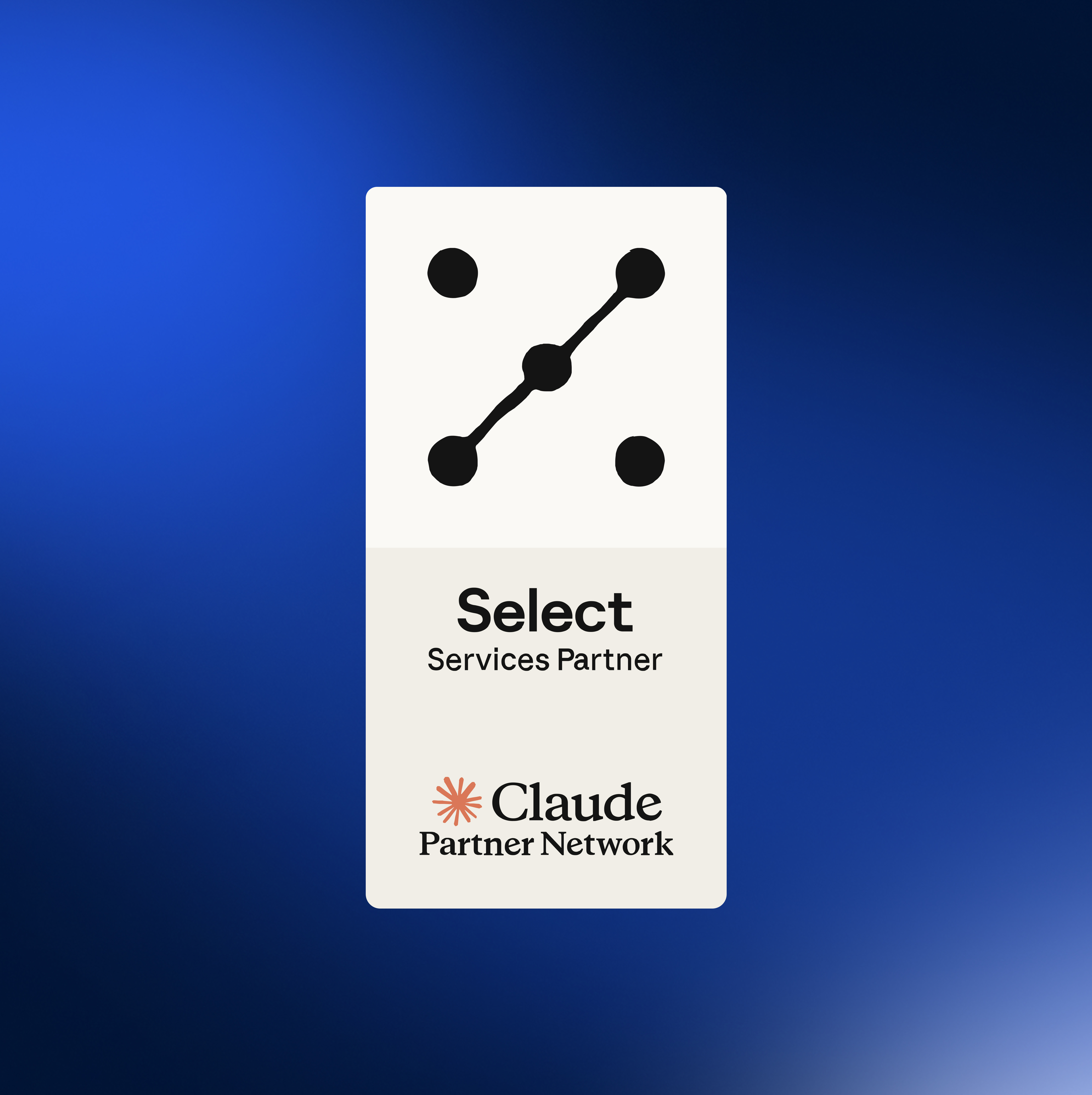
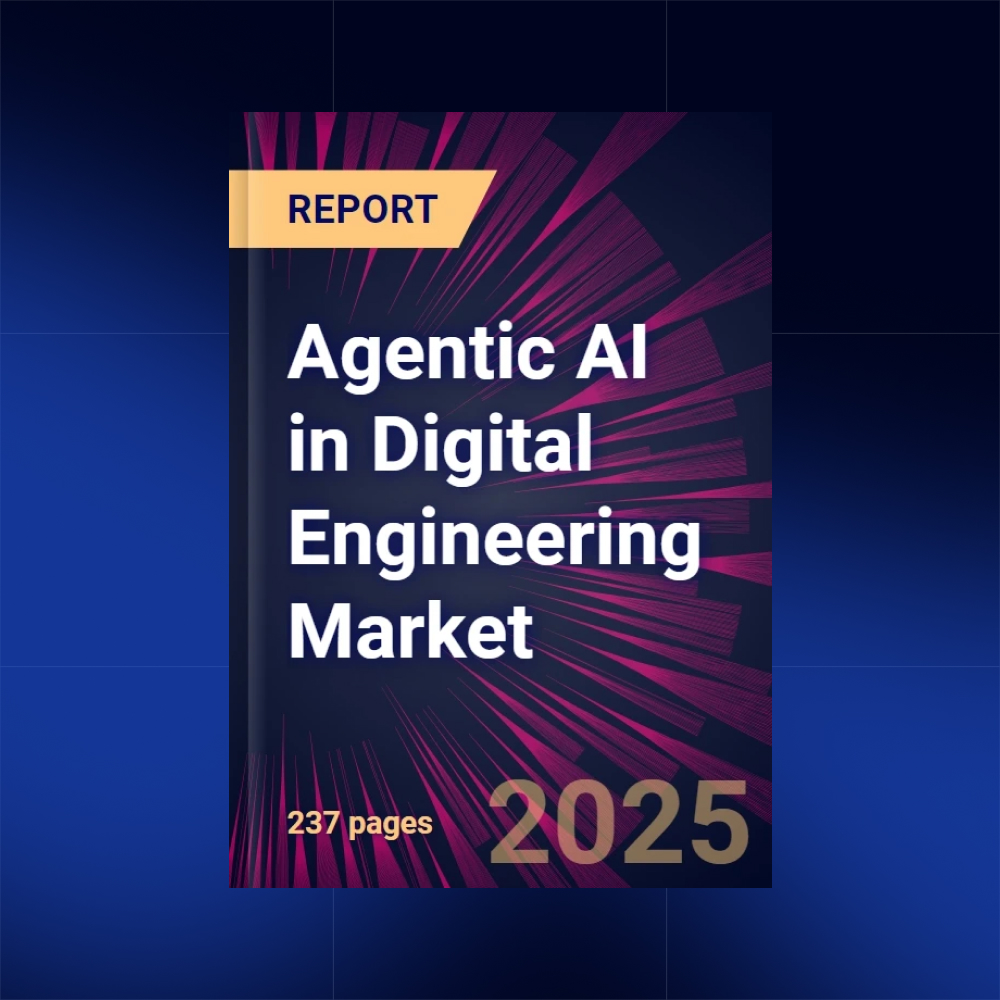
EffectiveSoft is a Select partner in the Claude Partner Network Services Track. We are also recognized as a key player in agentic AI in the global report “Agentic AI in Digital Engineering Market 2025–2029” by Research and Markets, listed alongside NVIDIA, OpenAI, Google Cloud, and Accenture. Our AI consulting and development services have also earned Clutch recognition as a Top AI Agent Company, Top Artificial Intelligence Company, and Top Software Developer.
Services
Our experienced LLM company provides strategic counseling to organizations interested in taking advantage of LLMs for sustainable business growth. Through our LLM consulting, companies receive tailored implementation strategies and learn how to employ LLMs both ethically and securely for their unique business applications. This enables faster time-to-market, improved ROI, and competitive advantage through the implementation of disruptive business models.


We tailor pre-build LLMs to your domain by fine-tuning on targeted datasets and optimizing model settings for your specific use cases. To improve accuracy and reduce hallucinations, we apply reinforcement learning from human feedback (RLHF), advanced prompting, and Retrieval-Augmented Generation (RAG), all while following strict security and compliance practices.


Our LLM development company helps teams adopt pre-trained LLMs without additional customization or fine-tuning. We use proven implementation methods like API-based integration to embed LLMs in your systems and infrastructure, prioritizing model performance, reliance, and security.

If you need to build AI-powered software solutions like chatbots, speech recognition tools, or content creation apps, EffectiveSoft is ready to support you. We deliver high-performance, scalable, and secure systems that integrate advanced LLMs for a wide range of text-related tasks, from text editing and proofreading to personalized customer support.


For maximum effectiveness, you need an LLM development company to take full care of your models after deployment. To ensure the long-term operation of your LLMs, we monitor them for performance, security, and compliance; troubleshoot all issues as they arise; and update the models to accommodate the latest language trends and evolving user needs.


Do you want to ensure your LLMs are secure, scalable, and bias-mitigated? Tap into our end-to-end LLM operations (LLMOps) services. Drawing on our deep expertise in LLMOps techniques, tools, and best practices, we guide businesses in effectively managing the full life cycle of their LLMs, from model training to ongoing improvement.



“Off-the-shelf LLMs don’t always deliver the results businesses expect. But that’s usually a matter of fit, not capability. We make LLMs work for your business—tailor models to your data, your workflows, and your standards, transforming them from generic models into high-performing, production-ready AI systems that drive impact.”
Senior Engineer
Benefits

By integrating LLMs into their operations, organizations can automate virtually any task, from data entry to audio data analysis, speeding up company-wide processes and increasing overall productivity.

LLM-powered chatbots tailor customer support to meet unique user demands, identify friction points in interactions, and collect relevant feedback, creating ultra-personalized flows and flawless experiences 24/7.

Organizations that use language models for business and in-domain processes significantly reduce their operating costs by flagging potential compliance and security threats early and minimizing human error.

With LLMs, businesses can create engaging digital content that helps them decrease bounce rates, generate more leads, and reduce customer attrition, significantly boosting sales and profits.

LLMs help organizations extract and compile insights from both structured and unstructured data, enabling faster, better-informed decisions and earlier identification of risks and opportunities.

By deploying LLMs, organizations can differentiate their offerings, respond to market changes faster, and build competitive advantage through superior workflows, personalization, accelerated support, and more.
Solutions
We design and implement intelligent chatbots, virtual assistants, and AI agents powered by large language models. By combining natural language understanding with contextual memory and business logic integration, we create solutions that provide human-like responses while seamlessly connecting your CRM, ERP, or other enterprise systems, delivering 24/7 customer support and streamlining internal operations.

Native multimodal models can process and reason across text, images, audio, and video in real time. We leverage these capabilities to build AI-driven content solutions that generate high-quality text, summarize documents, extract key insights, and transform unstructured data into actionable knowledge, enhancing productivity and reducing manual effort across content-heavy workflows.


We implement AI-powered translation and language processing systems that enable seamless multilingual communication at scale. By training LLMS on domain-specific data, we ensure context-aware language output tailored to industry terminology and regional nuances, supporting real-time translation, localization, transcription, entity recognition, and semantic search across global markets.


Leveraging ML and LLM capabilities, we build personalization engines that analyze user behavior, preferences, and contextual signals to deliver highly relevant content, product recommendations, and user experience. These recommender systems increase engagement, improve retention, and maximize conversion rates. Our solutions are designed to integrate seamlessly with your existing data ecosystem.
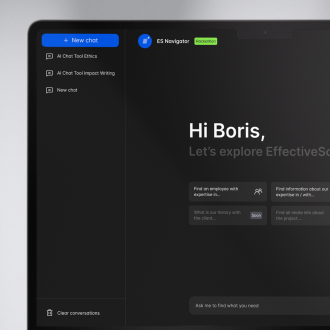

We incorporate NLP-based sentiment analysis into virtual assistants, chatbots, and other AI solutions, allowing businesses to enhance their products and services based on the collected customer feedback and evaluated text and voice sentiment. Our systems analyze reviews, support tickets, surveys, and social media conversions to identify trends and measure brand perception, enabling data-driven decisions.


Our enterprise LLM development services help organizations strengthen compliance, reduce risk, and enforce policy governance at scale. We build solutions that interpret and apply internal policies and regulatory requirements across operational workflows, flagging potential violations, automating review steps, and supporting secure handling of sensitive data.


Expertise
We combine supervised, semi-supervised, unsupervised, and reinforcement learning with scikit-learn, Keras, PyTorch, TensorFlow, and other frameworks to create powerful machine learning (ML) models for use cases like predictive analytics.
Our AI engineers use spaCy, NLTK, and TextBlob to build bespoke natural language processing (NLP) models with advanced generation and understanding capabilities for key phrase extraction and document categorization.
With our strong proficiency in cloud computing, we expertly guide our clients in deploying LLMs on suitable cloud platforms like OCI, AWS, Azure, and GCP. We ensure your models perfectly fit in the cloud and scale securely as user demand grows.
Our team of top-tier data specialists helps companies establish resilient and scalable data infrastructures to gather, process, and organize the massive amounts of text information required to train, fine-tune, and deploy high-quality and bias-free LLMs.
We introduced an AI assistant that reduced complex, multi-asset dashboard configuration time by around 60%.


A thorough analysis of a credit management company’s operations allowed us to map the AI opportunities capable of improving staff productivity and the customer experience, ultimately driving growth.


We helped bridge the healthcare data gaps with AI and NLP integration.


Want more?
View portfolioIndustries

The LLMs we create are used across the financial services sector for credit risk assessment, personalized customer service, investment sentiment analysis, and data synthesis for algorithmic trading.

We build advanced LLMs for healthcare administration, clinical transcription, automated patient communication, personalized treatment plans, medical coding and billing, drug discovery research, medical training, and diagnosis.

With the LLMs we develop, retail and e-commerce businesses improve customer service, enhance their marketing and sales strategies, boost product research and discovery, predict future product demand, and optimize inventory levels.

Models created by our LLM developers help logistics companies optimize transportation routes, enhance predictive maintenance, identify supply chain disruptions and bottlenecks, elevate customer support, and minimize costs.

Manufacturing organizations apply LLMs built by EffectiveSoft’s specialists for quality control and inspection, customer feedback analysis, demand forecasting, predictive maintenance, and supply chain management.

By implementing the LLMs we develop, e-learning companies create interactive and engaging lessons, personalize learning experiences to unique student needs, and offer LLM-powered language tutoring and practice.
Make the best of your text data with our comprehensive large language model development services, from LLM consulting to hallucination reduction.
| Model | Best for |
|---|---|
| OpenAI GPT-5/GPT-4o | Best overall versatility: conversations and creative writing, reasoning and complex problem solving, multimodal tasks, coding assistance and summarization |
| Anthropic Claude | Coding, technical, and analytical workflows, enterprise support and safety, technical content |
| Google Gemini | Large multimodal projects: research and analysis with large contexts, multimodal understanding |
| Meta LLaMA | Open deployment and customization, reasoning and coding when fine-tuned |
Process
Every LLM initiative begins with task decomposition. We define target workflows, user interaction patterns, compliance constraints, and measurable success criteria. Our team assesses whether the use case requires retrieval-augmented generation (RAG), tool-augmented reasoning, agentic orchestration, fine-tuning, or whether an LLM is inappropriate. The outcome is a technically defensible LLM roadmap grounded in feasibility, risk profile, and economic viability.
Our engineers design knowledge pipelines for structured and unstructured sources, implement chunking strategies, embedding selection, vector indexing, metadata enrichment, and access control policies. Retrieval logic is engineered to maximize grounding, minimize hallucination risk, and maintain traceability across documents and data domains. This phase defines whether the system operates as RAG, hybrid retrieval, or tool-augmented reasoning.
Next, we evaluate commercial APIs, open-weight models, and private deployments against latency, token economics, privacy constraints, security posture, and scaling requirements. Prompt engineering, structured outputs, tool calling, memory handling, and agent coordination are applied selectively. Fine-tuning is pursued only when evaluation metrics justify its cost and complexity.
Our specialists implement evaluation pipelines covering factual grounding, task completion, consistency, hallucination rates, policy adherence, and edge-case behavior. Guardrails include structured output validation, retrieval validation, fallback logic, human-in-the-loop review for sensitive flows, and abuse mitigation. Systems are engineered for auditability and controlled behavior under real-world conditions.
We then integrate LLM capabilities into internal tools, customer-facing applications, APIs, enterprise platforms, and workflow engines. Deployment architecture supports containerization, private endpoints where required, observability, and cost governance. This transforms the LLM from a demo assistant into operational infrastructure.
LLM solutions require continuous oversight. Our team monitors response quality, drift signals, user interaction patterns, latency, token usage, and cost per task. Optimization includes prompt refinement, retrieval tuning, workflow adjustments, model switching, or selective fine-tuning when supported by measurable gains. The objective is sustained reliability, controlled operating costs, and predictable business performance.
Why us

EffectiveSoft takes pride in its certified LLM developers, who bring strong expertise in solving complex business challenges through tailored AI solutions. Regardless of the depth of the problem, we have the up-to-date expertise to resolve it quickly and efficiently.

Our multicultural team of specialists from Europe, the UAE, LATAM, and the US works diligently to ensure our clients’ businesses keep running non-stop. Do you want to win more customers and skyrocket sales and revenue? Rely on our around-the-clock assistance.

Our expertise extends far beyond LLM development to include IT consulting, big data analytics, software quality assurance (QA) and testing, and more. We also successfully tackle problems in a wide range of industries, including healthcare, fintech, and trading.

Our ISO/IEC 27001:2022 certification and adherence to GDPR, PCI DSS, HIPAA, CCPA, and other regulations allow us to create ethical and secure AI solutions that effectively handle our clients’ sensitive data and firmly withstand potential and real-time threats.

EffectiveSoft acts with honesty and accountability to build long-term relationships with its clients. Our approach has won the trust of numerous companies, prompting them to choose us as their preferred partner and engage our services on repeated occasions.

Through our work, ideas crossing our clients’ minds become real-world products that address tangible business needs and pain points. We deliver solutions with thought-through functionality, intuitive UX design, superior quality, and lightning-fast speed.
Tech stack































The development of large language models is the process of creating AI models that are trained on large amounts of data and fine-tuned for specific business applications like translation and localization, question answering, market research, and customer support.
To ensure the high quality of the LLMs and AI solutions we create, we carefully curate training data, adhere to ethical AI strategies like model transparency and explainability, and implement strict security and privacy practices, including encryption and access controls. We also measure LLM accuracy and performance using effective evaluation and monitoring techniques, such as eyeballing and LLM-as-a-Judge, and conform to regulations like the EU AI Act.
Choosing EffectiveSoft, an experienced LLM development company, as your technical partner carries several notable benefits. Our LLM developers, who are Microsoft Azure AI–certified, have the in-demand generative AI (GenAI) skills needed to develop fully secure LLMs suitable for your industry- and domain-specific applications. Among our other strengths, EffectiveSoft’s clients and partners underscore our commitment to established contractual obligations, respect, empathy, a client-centered approach, and global accessibility.
The time required to build a custom LLM hinges on the amount of training data needed, the desired model size and complexity, the expertise of the development team, and other crucial factors. If you want an accurate time estimate for your LLM project, book a call now!
The cost of developing, training, and deploying a custom LLM from scratch depends on its complexity, size, and functionality; the levels of customization involved; data preprocessing requirements; and infrastructure needs. Are you interested in a price estimate for your bespoke LLM? Reach out to our consulting team now for more information.
When choosing the right LLM partner, prioritize the factors that will protect your business and determine your company’s competitive position in the long run. Start with security and compliance—your partner should handle data access, encryption, auditability, and regulatory requirements relevant to your industry. Full lifecycle capabilities also play a significant role, from data preparation and deployment to monitoring and long-term prioritization. To avoid inflated costs and missed deadlines, assess how they scope work, manage delivery, and measure success. Finally, validate the fit through a structured evaluation and real track record and references.
Future LLM development is moving in a few clear directions. High-quality, diverse training data is becoming a major differentiator, because it directly affects how well language models understand and generate text across real-world contexts. Ethical AI is also becoming standard, especially around bias mitigation and privacy protection. Companies are shifting from simple chatbots to autonomous AI agents that can execute multi-step tasks in real workflows. And as open-source models are catching up with proprietary models, enterprises are gaining more flexibility to customize their AI.
Large language models come with several common challenges, including data privacy and ethical concerns, bias and reliability issues, operational and safety risks, and hallucinations. As language models scale, the energy demands increase, raising concerns about their environmental impact and sustainability.
Large language models are typically trained with self-supervised learning on large text datasets. Development requires strong data preprocessing, substantial compute infrastructure, and performance evaluation with metrics like perplexity and cross-entropy. In production, LLMs are usually part of a modular stack (ingestion, embedding, retrieval, generation, and verification) with layered safety and guardrails to manage risks like hallucinations and bias. Python is the primary programming language, with TypeScript, Rust, and Go used for supporting services.
Popular LLM solutions include OpenAI’s GPT-5/GPT-4o, which is highly versatile for conversations, complex reasoning, and other tasks; Anthropic’s Claude, which is well suited for coding-heavy, technical, and analytical workflows; Google’s Gemini, which excels in large multimodal projects and research with large context analysis; and Meta’s LLaMA 2, an open-source LLM for research and commercial use.
RPA (Robotic Process Automation) is designed to automate structured, rule-based tasks by mimicking human actions in software systems, such as clicking buttons, copying data, or moving information between applications. It works best when processes are stable, repetitive, and clearly defined. LLMs (Large Language Models), on the other hand, automate cognitive and language-based tasks by understanding, interpreting, and generating natural language. They are suited for unstructured inputs, such as emails, documents, or conversations.
Prompt engineering involves designing custom prompts that align with an organization’s business objectives. This ensures that the Large Language Models (LLMs) they use generate more accurate, unbiased, and context-aware responses.
We utilize techniques like zero-shot and few-shot learning to create powerful LLMs. These methods help improve the accuracy and reliability of outputs, ultimately enhancing the user experience (UX).
Can’t find the answer you are looking for?
Contact us and we will get in touch with you shortly.
Our team would love to hear from you.
Fill out the form, and we’ve got you covered.
What happens next?
San Diego, California
4445 Eastgate Mall, Suite 200
92121, 1-800-288-9659
San Francisco, California
50 California St #1500
94111, 1-800-288-9659
Pittsburgh, Pennsylvania
One Oxford Centre, 500 Grant St Suite 2900
15219, 1-800-288-9659
Durham, North Carolina
RTP Meridian, 2530 Meridian Pkwy Suite 300
27713, 1-800-288-9659
San Jose, Costa Rica
C. 118B, Trejos Montealegre
10203, 1-800-288-9659